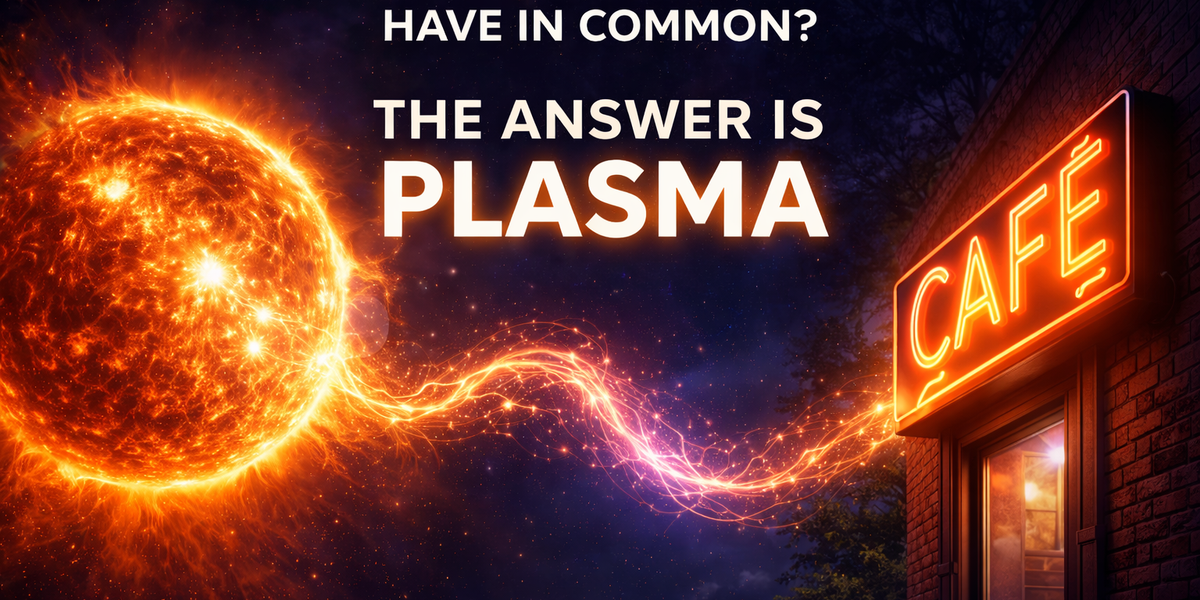
What Do Neon Signs and the Sun Have in Common? Plasma, the Fourth State of Matter
What do the Sun and a neon sign have in common? Both are connected by plasma, the fourth state of matter. Learn how plasma appears in stars and everyday life.
Look at the Sun. Then look at a glowing neon sign. They seem completely different, but they share something fascinating in common: plasma.
Plasma is called the fourth state of matter. It is not a solid, liquid, or ordinary gas. It is a high-energy state in which atoms become excited and charged particles can move more freely.
That means the glowing light in a neon sign is not just beautiful. It is showing you a form of matter that also exists in the Sun.
What Is Plasma?
Most students first learn three states of matter: solid, liquid, and gas. But there is a fourth one: plasma.
Plasma forms when a gas receives enough energy that its atoms become excited and some electrons are no longer tightly bound. This creates a mixture of charged particles that behaves differently from a normal gas.
Because of this, plasma can glow and respond strongly to electric and magnetic effects.
How Does a Neon Sign Create Plasma?
Inside a neon sign, neon gas is sealed inside a glass tube. When high voltage passes through the tube, the neon atoms become excited and begin to emit their well-known reddish-orange glow.
In these energized conditions, the gas can behave as plasma.
So when you see a neon sign glowing in the dark, you are not just seeing light. You are seeing an example of the fourth state of matter very close to everyday life.
Why Plasma Matters
Plasma is not only important in stars. It also matters in science, technology, and the future of energy.
Scientists study plasma in fields such as:
- fusion energy
- space science
- electronics
- advanced materials
That makes plasma one of the most important states of matter for understanding both the universe and future human technology.
Plasma in Everyday Life
Many students think physics only exists in labs, equations, or space research. But plasma shows that physics is much closer than that.
A glowing neon sign can become a simple way to observe an important scientific idea in the real world. It reminds us that the same laws of physics that shape stars also appear in everyday life.
Final Thought
So, what do the Sun and a neon sign have in common?
The answer is plasma.
One shines across the solar system. The other glows across a street. But both reveal the same fascinating state of matter: the fourth state of matter.
At MachinedMind, this is how we see science — not as something distant, but as something already around us, waiting to be noticed.
Frequently Asked Questions
What is plasma in simple words?
Plasma is the fourth state of matter. It forms when a gas gets so much energy that it contains charged particles and begins to behave differently from an ordinary gas.
Is the Sun made of plasma?
Yes. The Sun is made mostly of plasma, which exists there under extremely high temperature and pressure.
Is a neon sign made of plasma?
When electric current passes through neon gas in the tube, the energized gas can behave as plasma and produce its characteristic glow.
Why is plasma called the fourth state of matter?
It is called the fourth state of matter because it is different from solids, liquids, and gases, with unique behavior caused by charged particles.
Want to explore more hidden physics in everyday life? WhatsApp MachinedMind for simple, powerful explanations of science that connect the classroom to the real world.

MachinedMind Team