Private vs Government Olympiad: The Real Roadmap for IIT, Ivy League & Global STEM Admissions
SOF, private Olympiads, IOQM, NSEJS, and HBCSE Olympiads? It explains which Olympiads actually matter for STEM admissions, IIT pathways, Ivy League profiles, and long-term academic growth.
The Olympiad Illusion: Separating Commercial Noise from Elite Academic Credentials
Walk into any leading school today, or scroll through a parent WhatsApp group, and you will see the same pattern: “Olympiad” exams everywhere.
Some begin as early as Class 1. Some promise international rankings. Some offer medals, certificates, and glossy reports.
For ambitious parents, this creates immediate anxiety.
- Is my child falling behind?
- Should we register for every Olympiad?
- Will these certificates help in Ivy League, IIT, IISc, or top global university admissions?
Here is the strategic reality we share at MachinedMind Education:
- Not every Olympiad is an admissions credential.
- The Olympiad ecosystem is divided into two very different worlds.
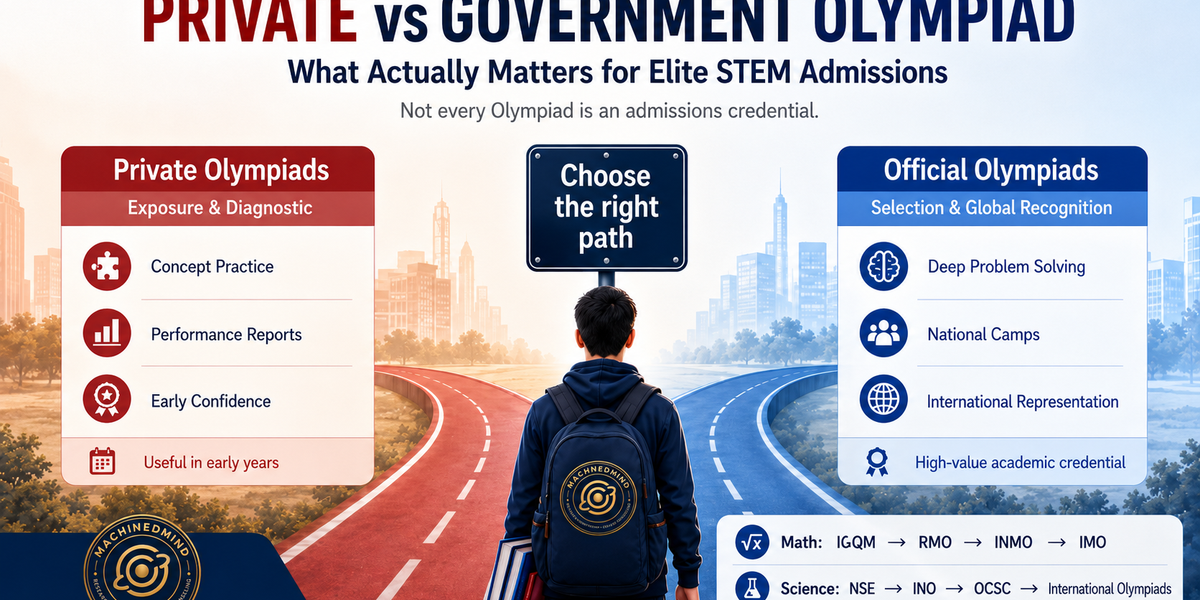
- Private Olympiads are useful for exposure, diagnostics, and early academic confidence.
- Official government-backed Olympiads are serious national selection pipelines that can become globally respected STEM credentials.
- Both may have value. But they do not have the same value.
- The mistake many parents make is treating every medal, certificate, and “international rank” as equal. They are not equal.
- A commercial Olympiad medal in Class 4 and a student qualifying through IOQM, RMO, INMO, NSE, INO, OCSC, or an official international Olympiad are not in the same academic category.
- The goal is not to dismiss private Olympiads.
- The goal is to use them at the right age, for the right purpose, and then pivot at the right time.
Are Private Olympiads Useful?
Yes — but mainly as diagnostic and exposure tools.
When parents hear “Olympiad,” they are usually hearing about private exams conducted by educational foundations, companies, or assessment bodies.
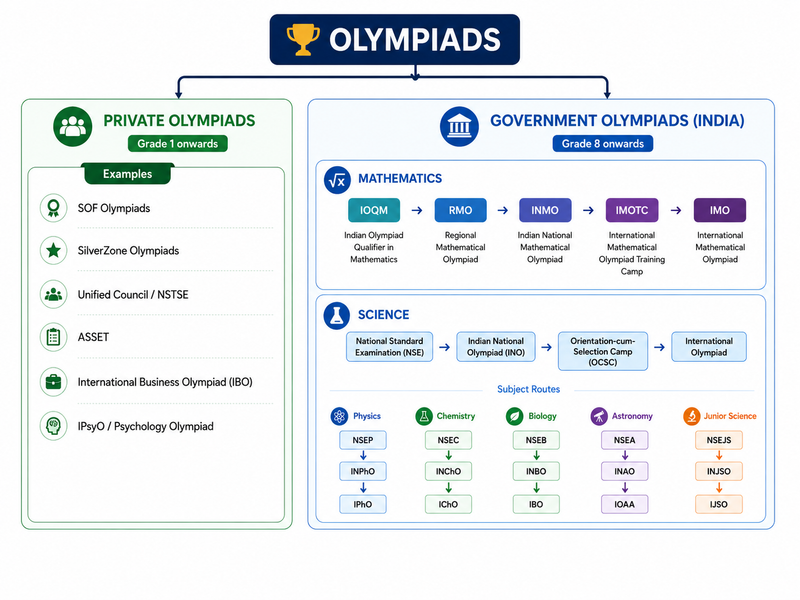
Examples include SOF Olympiads such as IMO, NSO, and IEO, SilverZone Olympiads, Unified Council assessments, NSTSE-style exams, and ASSET-type diagnostic tests.
These exams are usually school-distributed, fee-based, and designed for mass participation.
For younger students, especially Classes 1 to 7, they can be useful.
Where Private Olympiads Help
Private Olympiads can help children move beyond textbook recall.
Many school exams reward memorization. A well-designed private Olympiad question may ask the student to apply a familiar concept in an unfamiliar format.
They also introduce students to timed MCQ testing.
This matters because children slowly learn how to manage time, eliminate wrong options, read tricky wording carefully, and handle the pressure of an exam format.
Some platforms also provide performance reports.
These reports can help parents identify whether a student is struggling in geometry, number sense, grammar, logical reasoning, scientific application, or reading comprehension.
So, are private Olympiads useful? Yes — if you use them as academic games, confidence builders, and diagnostic tools. But they become harmful when parents start treating them as elite admissions achievements.
SOF vs Government Olympiad: The Real Difference
This is the line parents must understand clearly.
- A private Olympiad is usually an exposure exam.
- An official government-backed Olympiad is a national selection system.
- The difference is not just difficulty. The difference is purpose.
- Private Olympiads are designed for broad participation.
- Official Olympiads are designed to identify a very small group of exceptional students who can represent India at the highest international academic level.
- A private Olympiad may test speed, accuracy, pattern recognition, and syllabus-based application.
- An official Olympiad tests deep problem-solving, originality, proof-writing, experimental thinking, and conceptual maturity. That is why the admissions value is different.
- A high rank in a private Olympiad may show early interest. But by itself, it is not comparable to clearing IOQM, RMO, INMO, NSE, INO, OCSC, IMOTC, or representing India at an official international Olympiad.
- For elite STEM admissions, private Olympiad medals are usually weak standalone credentials unless they are supported by deeper evidence: advanced projects, original research, national-level selection, strong academic performance, or sustained subject excellence.
- Parent warning: Do not confuse “international participation” with “official international Olympiad selection.”
- Many private exams use international branding. Official international Olympiads follow national selection pipelines.
Official International Olympiads: The Real Academic Currency
The official Olympiad route is a different world.
In India, the official science and mathematics Olympiad ecosystem is connected to institutions such as HBCSE, TIFR, MTAI, IAPT, and NBHM.
- HBCSE: Homi Bhabha Centre for Science Education
- TIFR: Tata Institute of Fundamental Research
- MTAI or MTA(I): Mathematics Teachers’ Association (India)
- IAPT: Indian Association of Physics Teachers
- NBHM: National Board for Higher Mathematics
- DAE: Department of Atomic Energy
- NCSM: National Council of Science Museums
This is the pipeline that eventually leads to official international Olympiads such as:
- International Mathematical Olympiad (IMO)
- International Physics Olympiad (IPO)
- International Chemistry Olympiad (ICO)
- International Biology Olympiad (IBO)
- International Olympiad on Astronomy and Astrophysics (IOAA)
- International Junior Science Olympiad (IJSO)
These are not generic school exams. These are national selection systems. The difference becomes obvious at higher stages. Students are no longer simply selecting answers from multiple-choice options. They are solving demanding problems, writing multi-step arguments, designing logical approaches, and explaining why their answer must be true. In mathematics, this means subjective proof-writing. A proof is not just the final answer. It is a structured argument showing that a result must hold under all given conditions. In science, later stages may involve advanced conceptual reasoning, practical orientation, laboratory thinking, and problem-solving beyond routine board or school syllabi. This is why official Olympiad achievement carries much stronger academic credibility.
The Official Mathematics Olympiad Pathway
For mathematics, the Indian pathway begins with IOQM (Indian Olympiad Qualifier in Mathematics).
The broad route is:
IOQM → RMO → INMOTC → INMO → IMOTC → Pre-Departure Camp → IMO
Each stage becomes more selective.
Stage 1: IOQM
IOQM is the first major gateway.
It is a three-hour exam with 30 questions. Answers are typically single-digit or two-digit numbers marked on an OMR sheet.
This format may look simple, but it is not easy.
The absence of options means students cannot rely on elimination. They must actually solve the problem and arrive at the correct integer answer.
Stage 2: RMO
RMO stands for Regional Mathematical Olympiad.
This is a major shift from answer-based testing to proof-based problem-solving. Students are expected to write full solutions, not just final answers.
Stage 3: INMOTC and INMO
At this level, students are trained regionally and then selected for the Indian National Mathematical Olympiad.
INMO is one of the most respected school-level mathematics achievements in India.
Stage 4: IMOTC
Top INMO performers are invited to the International Mathematical Olympiad Training Camp.
At IMOTC, students undergo intensive training and selection tests.
Final Stage: IMO
A team of six students is selected to represent India at the International Mathematical Olympiad.
This is why the official mathematics Olympiad route is considered a serious academic credential.
It is not based on one school-level test. It is a multi-stage national filtration system.
The Official Science Olympiad Pathway
For science subjects, the route usually begins with the National Standard Examinations
The senior science tracks include:
- NSEP for Physics
- NSEC for Chemistry
- NSEB for Biology
- NSEA for Astronomy
The junior science route includes: NSEJS for Junior Science
The broad science route is:
NSE → INO → OCSC → Pre-Departure Training → Official International Olympiad
What Makes the Science Route Different?
The science Olympiad pathway is not just about knowing more chapters.
It tests whether a student can think like a scientist.
At the early stage, students need strong conceptual clarity.
At the higher stages, they need the ability to reason through unfamiliar problems, interpret data, and connect ideas across topics.
The Orientation-cum-Selection Camp, or OCSC, is especially important.
It is not simply another exam. It is a national camp where top students are trained, evaluated, and considered for international representation.
For students targeting elite STEM universities, even reaching advanced national stages can become a powerful academic signal.
HBCSE Olympiad Eligibility Criteria: What Parents Should Know
A major difference between private and official Olympiads is eligibility. Private Olympiads may offer exams from very early grades. Official Olympiads do not work that way. They are designed for students who are old enough to handle advanced analytical thinking. Eligibility also changes by year, subject, citizenship status, school system, and official policy updates. Parents should always verify the current year’s official documents before registering. Still, the general structure is clear.
Mathematics
- First major entry exam: IOQM
- Usual student profile: Classes 8 to 12, subject to age and official eligibility rules
- Strategic meaning: Best route for students with deep mathematical problem-solving ability
Junior Science
- First major entry exam: NSEJS
- Usual student profile: Usually middle or high school students within a strict age window
- Strategic meaning: Strong route for students before they specialize into Physics, Chemistry, Biology, or Astronomy
Physics
- First major entry exam: NSEP
- Usual student profile: Mostly senior school students
- Strategic meaning: Useful for students strong in mechanics, electricity, optics, and conceptual physics
Chemistry
- First major entry exam: NSEC
- Usual student profile: Mostly senior school students
- Strategic meaning: Useful for students with strong theoretical and problem-solving chemistry
Biology
- First major entry exam: NSEB
- Usual student profile: Mostly senior school students
- Strategic meaning: Useful for students interested in life sciences, medicine, biotechnology, and biology research
Astronomy
- First major entry exam: NSEA
- Usual student profile: Mostly senior school students
- Strategic meaning: Useful for students interested in physics, astronomy, astrophysics, and space science
- Parents should not rely only on class labels.
- Official Olympiad eligibility is often age-based and policy-based.
IOQM 2026 Exam Pattern and Eligibility
For IOQM 2026, students must check the official eligibility criteria carefully.
As per the official IOQM 2026 eligibility document, students studying in Classes 8, 9, 10, 11, or 12 and born within the specified official date range are eligible, subject to additional conditions related to passport eligibility, OCI rules, school system, Class 12 status, and university enrollment.
The IOQM exam structure is strategically important.
- Duration: 3 hours
- Questions: 30
- Mode: Offline, OMR-based
- Answer type: Integer answers, usually from 00 to 99
- Total marks: 100
- Marking structure: 10 questions of 2 marks, 10 questions of 3 marks, and 10 questions of 5 marks
- Negative marking: Usually none
This creates a very specific preparation challenge. A student cannot depend on speed alone. They must develop clean mathematical thinking. They must know how to approach geometry, number theory, combinatorics, and algebra in unfamiliar forms. This is why Class 8 is such an important entry point. By Class 8, a mathematically inclined student can begin serious Olympiad-style preparation. But this preparation is very different from regular school math or even standard board preparation.
NSEJS Eligibility Class 8: What Parents Should Understand
Many parents ask: Can a Class 8 student appear for NSEJS?
The answer depends on the official eligibility rules for that cycle.
NSEJS is not simply a “Class 8 exam.” It is an age-window-based junior science pathway. Many eligible students may be in Classes 8, 9, or 10, but the exact rules must be checked every year through the official HBCSE/IAPT information.
Strategically, however, Class 8 is a very important year.
This is when a strong student can begin developing serious science reasoning before the pressure of Class 10 boards, JEE, NEET, APs, IB, A Levels, or other high-stakes academic systems begins.
For a student who enjoys physics, chemistry, biology, and scientific reasoning, NSEJS can be an excellent transition from “school science” to “real science problem-solving.”
What About SCOPE and IIT Admissions?
- One major reason official Olympiads matter more today is that India’s top institutions are beginning to formally recognize Olympiad excellence.
- The SCOPE route, or Science Olympiad Excellence admission route, has introduced a formal pathway for eligible Olympiad achievers at participating IITs.
- This does not mean every Olympiad participant gets direct admission. It also does not mean private Olympiad medals qualify.
- SCOPE is tied to serious official Olympiad achievement and comes with specific eligibility conditions. Students must satisfy the official rules for the relevant year, including academic requirements, subject eligibility, and qualifying Olympiad-camp or international Olympiad performance.
- The larger message is clear: Official Olympiad achievement is no longer just a medal. It is becoming a recognized academic signal inside elite admissions ecosystems.
- That is why parents should treat the official Olympiad route with strategic seriousness.
MachinedMind Education Roadmap: Class-Wise Strategy
The best Olympiad strategy is not “do everything.” The best strategy is knowing what to do at each stage — and what to stop doing.
Classes 1 to 4: Exploration, Not Pressure
- At this stage, private Olympiads can be used lightly.
- The goal is not ranking. The goal is exposure.
- Choose one or two exams only if the child enjoys them. Do not overload the student with every available Olympiad, coding test, English test, science test, and logic test.
- At this age, curiosity matters more than certificates.
Classes 5 to 7: Diagnostic Window
This is the best time to use private Olympiads more intelligently.
Parents can look at performance reports and ask:
- Is the child strong in reasoning?
- Does the child enjoy non-routine math?
- Is science application stronger than memorization?
- Is the child comfortable with time pressure?
- Does the student show curiosity beyond school textbooks?
This is also the stage where students can begin puzzle-based math, reading-heavy science, logic building, and project-based learning.
Classes 8 to 10: The System Pivot
This is the most important transition.
By Class 8, parents should stop treating private Olympiad medals as the main goal. If the student has genuine aptitude, the focus should shift toward official pathways such as IOQM or NSEJS.
This is also the right time to build deeper academic habits:
- Writing full solutions
- Reading advanced textbooks
- Solving non-routine problems
- Learning proof-based thinking
- Building small but meaningful STEM projects
- Exploring research questions
For high-potential students, Class 8 to 10 is where academic identity begins to form.
Classes 11 and 12: Peak Portfolio Strategy
In senior school, time becomes limited.
Students are balancing boards, JEE, NEET, APs, IB, A Levels, SAT/ACT, research, extracurriculars, and university applications.
At this stage, the student must choose carefully.
For some students, the right strategy is official Olympiad depth through NSEP, NSEC, NSEB, NSEA, INO, or OCSC.
For others, especially those targeting Ivy League or global universities, the better strategy may be a combination of:
- Publication-grade STEM research
- Advanced prototypes or software builds
- Independent mathematical or scientific investigations
- Strong essays and intellectual positioning
- Carefully selected competitions
- University-level coursework or mentorship
The right roadmap depends on the student’s strengths. A student should not chase every exam. A student should build a coherent academic story.
Private vs Government Olympiad: The Parent Decision Framework
Before registering for any Olympiad, parents should ask five questions.
1. Who conducts the exam?
Is it a private organization, a school-distributed commercial exam, or part of the official national Olympiad pathway?
2. What is the selection depth?
Is it a one-level exam, or does it lead to regional, national, camp, and international stages?
3. What skill does it test?
Does it test MCQ speed, syllabus recall, conceptual application, proof-writing, experimental thinking, or original reasoning?
4. What is the student’s age?
A Class 3 student does not need an elite Olympiad strategy. A Class 8 student may.
5. Will this credential matter later?
Will the result meaningfully help the student’s academic profile, or is it mainly a confidence-building exercise?
This simple framework protects students from burnout and protects parents from marketing noise.
The Brutal Truth About Olympiad Medals
Many children receive medals. Very few enter official national selection pipelines. That does not mean private medals are useless. It means parents must interpret them correctly. A medal in a private Olympiad can encourage a young student. It can reveal interest. It can help the child feel motivated. But for elite admissions, the real question is deeper:
What did the student build after that interest was discovered?
- Did they pursue advanced problem-solving?
- Did they develop research maturity?
- Did they build prototypes?
- Did they write serious essays or papers?
- Did they reach national-level selection?
- Did they show intellectual independence?
Elite admissions committees are not looking for children who collected the most certificates. They are looking for students who show depth, initiative, and evidence of serious academic growth.
FAQ: Official International Olympiads and Admissions Strategy
Q1. Should my child attempt private Olympiads?
Yes, but mainly in the early years. Use them for exposure, confidence, and diagnostics. Do not overinvest emotionally or financially in private medals.
Q2. Are private Olympiads useful for Ivy League admissions?
By themselves, usually not much. A private Olympiad medal may show early academic interest, but it is not comparable to official national or international Olympiad achievement. It becomes useful only as part of a larger academic story.
Q3. Which Olympiads matter most for elite STEM admissions?
Official Olympiad pathways matter most: IOQM, RMO, INMO, IMOTC, NSE, INO, OCSC, and official international Olympiads such as IMO, IPhO, IChO, IBO, IOAA, and IJSO.
Q4. Can a Class 8 student start official Olympiad preparation?
Yes, Class 8 can be an excellent starting point for mathematically or scientifically advanced students. IOQM and NSEJS-related preparation can begin around this stage, depending on eligibility and readiness.
Q5. Should students prepare for both Olympiads and research?
It depends on the student. Some students are natural Olympiad problem-solvers. Others are stronger in research, innovation, writing, coding, or building prototypes. The best portfolio strategy is personalized, not generic.
Q6. What should parents avoid?
Avoid registering for every exam. Avoid comparing medals without understanding credibility. Avoid pushing a student into advanced Olympiad preparation without genuine interest or readiness.
Final Takeaway: The Real Olympiad Strategy
The smartest families do not chase every Olympiad. They understand the difference between exposure and credentials.
Private Olympiads can be useful in the early years. They help children experience competition, develop test confidence, and identify strengths.
But official government-backed Olympiads are the serious academic pathway. They test depth, originality, discipline, and national-level excellence.
The real strategy is simple:
- Use private Olympiads early.
- Use official Olympiads seriously.
- Use research, prototypes, and mentorship to build depth.
- Never let certificate collection replace intellectual growth.
At MachinedMind Education, we help students and parents make this transition thoughtfully — from scattered competitions to a focused academic roadmap built around curiosity, rigor, and long-term excellence.
Because the goal is not just to win another medal. The goal is to build a student who can think deeply, solve hard problems, and stand out in the world’s most competitive academic environments.
References and Sources
- Homi Bhabha Centre for Science Education (HBCSE), TIFR. “Olympiads.”
https://olympiads.hbcse.tifr.res.in/ - Homi Bhabha Centre for Science Education (HBCSE), TIFR. “Stages of Mathematical Olympiad.”
https://olympiads.hbcse.tifr.res.in/about-olympiads/stages/mathematical-olympiad/ - Homi Bhabha Centre for Science Education (HBCSE), TIFR. “Stages of Science Olympiad.”
https://olympiads.hbcse.tifr.res.in/about-olympiads/stages/science-olympiad/ - Mathematics Teachers’ Association (India). “IOQM 2026–2027.”
https://www.mtai.org.in/ioqm-2026/ - Indian Olympiad Qualifier in Mathematics. “IOQM 2026 Official Website.”
https://ioqm.mtai.org.in/ - IIT Madras Undergraduate Admissions. “Science Olympiad Excellence Admission (SCOPE) 2026.”
https://ugadmissions.iitm.ac.in/scope/ - International Mathematical Olympiad. “Official IMO Website.”
https://www.imo-official.org/ - International Physics Olympiad. “IPhO Official Website.”
https://www.ipho-new.org/ - International Chemistry Olympiad Steering Committee. “IChO Steering Committee.”
https://www.ichosc.org/ - International Biology Olympiad. “IBO Official Website.”
https://www.ibo-info.org/en/ - International Information Centre of the International Chemistry Olympiad.
https://icho.sk/ - Science Olympiad Foundation. “SOF Official Website.”
https://sofworld.org/ - Science Olympiad Foundation. “SOF Results Portal.”
https://results.sofworld.org/results - SilverZone Foundation. “Olympiads, Talent Search Exams & Academic Competitions.”
https://www.silverzone.org/ - Unified Council. “Olympiad Exams and NSTSE.”
https://www.unifiedcouncil.com/ - Educational Initiatives. “Ei Study.”
https://ei.study/ - Educational Initiatives. “ASSET Talent Search.”
https://registration.ei.study/
Note: Olympiad eligibility rules, registration dates, exam structures, and admission policies can change each year. Parents and students should verify the latest cycle-specific rules from the official HBCSE, MTAI/IOQM, IAPT, and IIT SCOPE websites before making academic or admissions decisions.

MachinedMind Team