How Clocks Work: The Technology Behind Satellites, Finance, and Navigation
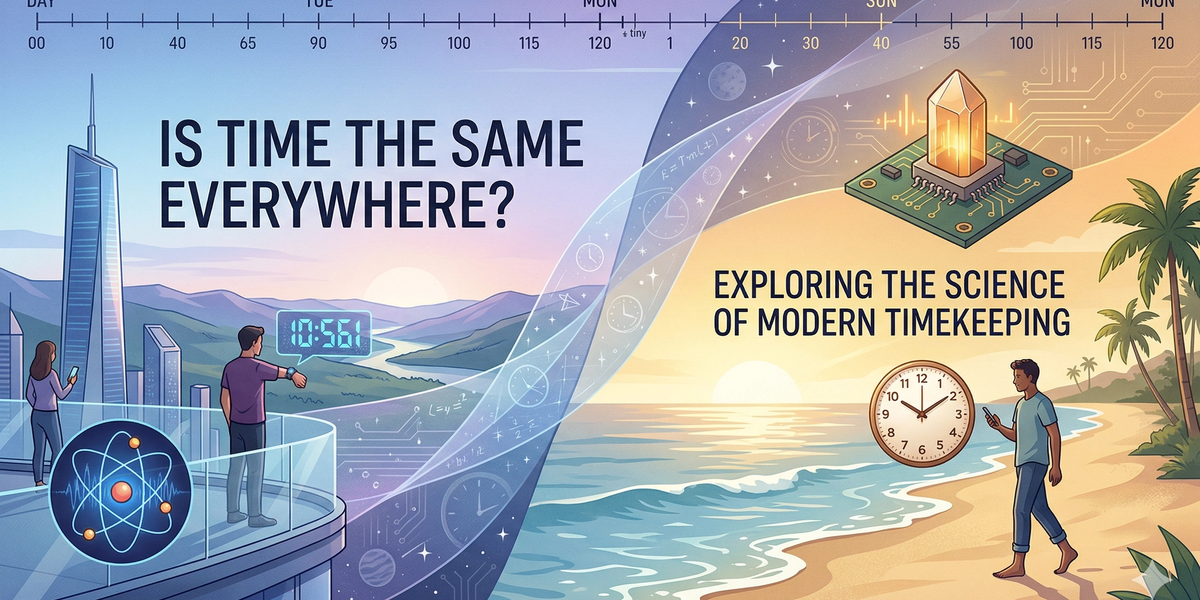
If you stood at the top of the Burj Khalifa and I stood on the beach, our clocks would no longer match after 24 hours. Why? it’s a measurement of motion, vibrations, and atoms.
Table of Contents
- The Burj Khalifa Mystery
- Why clocks at the top tick faster than those at the beach.
- What is a Clock Actually Doing?
- Spoiler: It doesn’t actually "know" what time is.
- Mechanical vs. Digital: Counting the Ticks
- From physical gears to the invisible vibrations of quartz.
- The Magic of Quartz: The Piezoelectric Effect
- Why a tiny crystal is the heartbeat of your wrist and your laptop.
- Atomic Clocks: Accuracy Over Millions of Years
- The role of Cesium-133 and why "one second" is no longer a guess.
- Why Einstein Changes Everything
- General Relativity and why time is not a constant.
- From Satellites to Stock Markets
- How precise timing powers GPS, finance, and global communication.
- The Future of Time
- Optical clocks and the next generation of navigation technology.
- Careers in Timekeeping
- Industries and roles where nanoseconds mean everything.
If one person is standing at the top of the Burj Khalifa and another is walking on the beach, will their clocks show exactly the same time after a day?
It feels like the answer should be yes. A second is a second, no matter where you are. Whether you are hundreds of meters above the ground or right next to the sea, time should move the same way.
But it doesn’t.
If both of them carry perfectly accurate clocks, after one day, those clocks will not match exactly. The difference would be extremely small, almost impossible to notice, but it would be real. And the surprising part is that nothing is wrong with the clocks.
The real question then becomes:
What is a clock actually doing when it measures time?
What a clock really does
A clock does not understand time. It does not know what a “second” is.
All it does is follow something that repeats again and again, very consistently.
If that repetition is steady, we call it timekeeping.
Different clocks use different kinds of repeating patterns. That is what makes them different from each other.
Analog and digital clocks
Before going inside the mechanism, it helps to understand how we usually see clocks.
An analog clock shows time using moving hands. These hands rotate over a circular dial. The motion behind the hands can come from gears, springs, or electronic systems.
A digital clock shows time using numbers. Inside, it is usually electronic. Even though it looks very different, most digital clocks still depend on vibrations or signals to count time.
So the display is different, but the core idea remains the same. Both are counting something that repeats.
Mechanical clocks: time through motion
The earliest accurate clocks were mechanical.
Inside them, there is a simple idea. Energy is stored, released slowly, and controlled.
A spring stores energy when you wind the clock. This energy moves a set of gears. The gears do not spin freely. A small control mechanism allows them to move step by step.
That controlled movement creates the familiar ticking sound.
Each tick represents a small, regular movement. The clock counts these movements, and that becomes time.
The clock is not measuring time directly. It is measuring motion that is carefully controlled.
Quartz clocks: time through vibrations
Mechanical clocks worked well, but they were not perfectly reliable. Their accuracy depends on physical parts that can wear out or get affected by temperature.
This is why modern clocks use quartz.
Quartz is used because it has a very special property called the Piezoelectric Effect.
When electricity passes through a quartz crystal, it vibrates at a very precise and stable frequency. This vibration does not change easily with time, temperature, or usage.
That is why quartz is preferred. It is:
- very stable
- inexpensive
- easy to manufacture
- highly accurate for everyday use
Most quartz clocks use a frequency of 32,768 vibrations per second. The clock counts these vibrations and converts them into seconds.
Can we use other materials instead of quartz?
Yes, but quartz is the most practical choice.
Other materials like silicon or certain ceramics can also vibrate, but they are either more expensive, less stable, or harder to manufacture at scale.
In very advanced systems, scientists use completely different approaches, such as atoms or lasers. These are not used in everyday clocks because they are complex and costly.
Quartz sits in the perfect balance between cost, accuracy, and reliability. That is why it became the standard.
Atomic clocks: time through atoms
For everyday use, quartz clocks are enough. But for systems like satellites, even tiny errors matter.
Atomic clocks go one step further.
Instead of relying on motion or crystals, they use atoms. Atoms behave in a very predictable way and vibrate at an exact frequency.
By measuring these vibrations, scientists can define time with extreme precision.
Atomic clocks are so accurate that they would not lose even one second over millions of years.
They are used in systems like the Global Positioning System, where precise timing is essential.
Which atoms are used in atomic clocks?
The most commonly used atom is cesium (Cs).
Why cesium?Cesium atoms behave in a very stable and predictable way. In fact, the modern definition of time is based on cesium. One second is defined as 9,192,631,770 vibrations of a cesium atom. This is the global standard used everywhere.
Where are cesium clocks used? GPS satellites National time standards Scientific measurements
Are there other atoms used?
Yes, more advanced atomic clocks use different atoms.
Rubidium Used in smaller and more compact systems such as satellites and communication networks.
Hydrogen Used in very high-precision research systems where short-term stability is important.
Optical clocks (latest research) Use atoms like strontium and ytterbium, and are even more accurate than cesium-based clocks.
Coming back to the Burj Khalifa and the beach
Now the earlier question starts to make more sense.
Even if both people are using the most accurate clocks, the results can still be slightly different.
That is because the difference does not come from the clock.
It comes from how time itself behaves in different conditions, something explained by General Relativity.
The clock is simply following time.
And time is not as constant as we once believed.
Where can you go from here?
If this idea interests you, there are many directions you can explore further.
What happens to time in satellites compared to Earth? You can study how satellite clocks differ from ground clocks and how systems like GPS correct these differences.
How accurate does a clock need to be for navigation to work? You can model how tiny errors in time lead to large errors in location.
Can time differences be measured between different heights on Earth? This can be explored using simulations or existing experimental data.
How do modern systems keep time synchronized across the world? This connects to how the internet, financial systems, and communication networks depend on precise timing.
How are newer optical clocks improving accuracy? This leads into current research where scientists are building clocks that are even more precise than those used today.
Where does this lead in the real world?
Work in this area connects directly to industries that already exist today.
Navigation and location systems Companies like Google and Apple work on maps and location services. Roles here include navigation systems engineer and location data engineer, where accurate timing is essential.
Semiconductor and communication systems Companies such as Qualcomm, Intel, and Broadcom design chips and systems that rely on precise timing. Roles include embedded systems engineer and communication systems engineer.
Space and satellite systems Organizations like NASA and European Space Agency, along with companies like SpaceX, work on satellites and navigation systems. Roles include satellite systems engineer and mission engineer.
Financial and distributed systems Modern financial systems depend on accurate timestamps. Companies such as Visa and Mastercard rely on precise timing for transactions. Roles include systems engineer and infrastructure engineer.
Emerging areas There is growing work in secure time synchronization, quantum communication, and distributed systems. Companies like IBM and research labs are actively working in these areas.
A simple way to think about it
A clock might look simple, but the moment you start asking how it works, it connects to:
- satellites
- navigation
- communication networks
- financial systems
- and future technologies
This is one of those areas where a basic question can lead to very real and meaningful careers.

MachinedMind Team