
Career Guidance for High School Students: A 8-Category Framework to Choose the Right Career (Part 1)
During career counseling sessions, we regularly meet Grade 9 and Grade 10 students who struggle with the question: Which career path should I choose? This confusion is understandable. Today’s students are exposed to a vast number of options, from traditional professions to emerging fields such as artificial intelligence, finance, space science, material science, and entrepreneurship.
At the same time, students often make decisions without enough exposure to what these careers actually look like in the real world. If they are guided by people who have worked in leading technology companies, finance firms, and cutting-edge research environments, they can make far more informed choices.
This is where MachinedMind comes in. At MachinedMind, students learn from industry experts, PhDs, CFAs, and professionals who are at the top of their fields. Our mentors do not just explain career paths in theory; they also share the realities, challenges, and invaluable lessons from their own journeys.
While career guidance should ideally be personalized for each student, we are sharing a general framework in this article so that even students who are not yet part of MachinedMind can gain some direction and clarity.
Before using this framework, a student needs to understand or mull over their natural inclination and then pick which of the following categories they belong to. These categories are overlapping and most of the students can feel that they belong to the two categories simultaneously. That feeling is alright and that’s why we had mentioned earlier that each student needs a customized plan for him/her.
- Students looking for job security want to land a high paying job
- Students who want to create social impact through climate change, women’s safety, or education
- Students who want to do research, become scientists, and go for a PhD
- Students who want to become founders like Elon Musk
- Students who are inclined toward arts, creativity, design, or media
- Students who want careers that are less likely to be replaced by AI (Mechanical, Civil, Electrical, Aerospace, Aviation)
- Students who want to become like someone they have seen closely — a doctor, lawyer, engineer, investor, or professor
- Students who are still figuring out what excites them
1. Students looking for job security and a high-paying career
Let us start with the first category: students who are looking for job security and a high-paying career. Many students in Grades 9 and 10 naturally think about which fields could provide strong career stability and financial growth in the future.
To understand this better, we can look at some of the technology careers that are leading to high-paying jobs in 2025, based on the Technology Salary Guide 2025: Global Market Insights published by Michael Page.
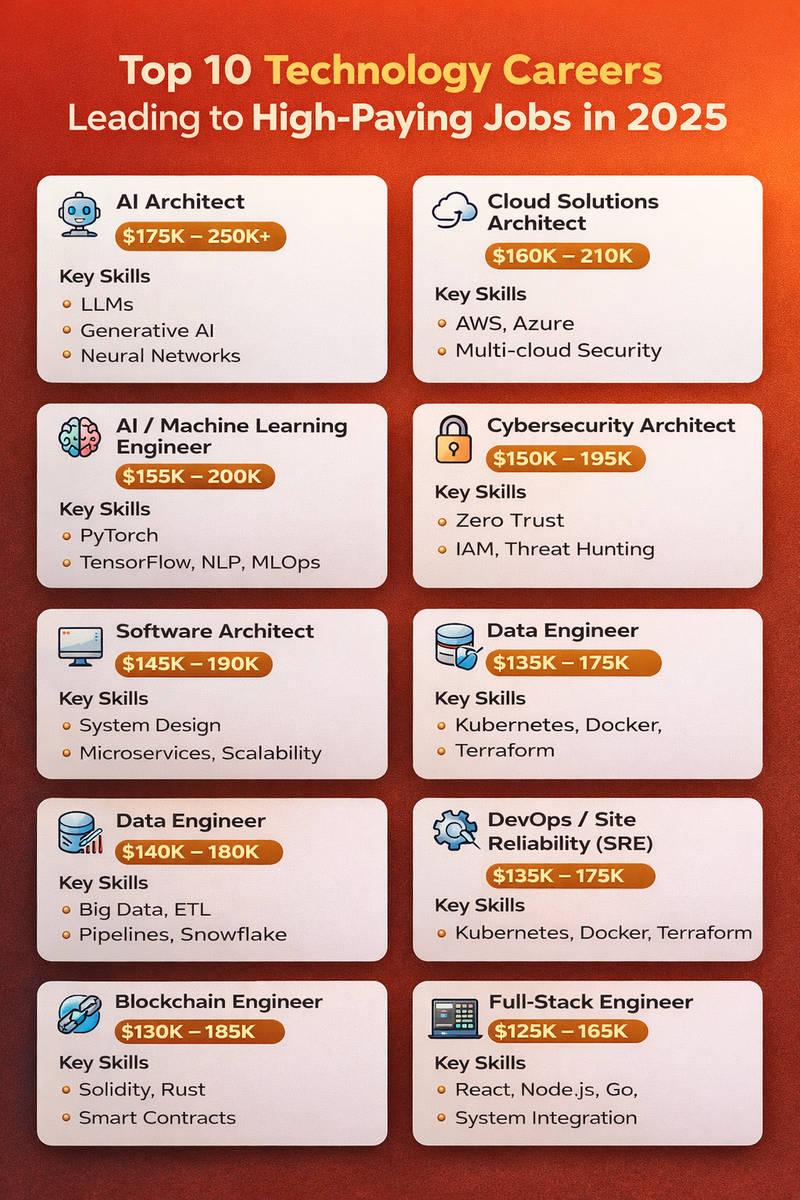
The figure above highlights several such careers. Among them, AI Architect and Blockchain Engineer stand out as two particularly exciting technology paths. But an important question arises:
How can a high-school student begin exploring these fields early? Below are some practical steps students can take if they are interested in these areas.
If a student is interested in Artificial Intelligence and Machine Learning
Students who enjoy mathematics, coding, data, and problem solving often find Artificial Intelligence an exciting field to explore.
Some early steps could include:
- Build a small data project
Students can start with a beginner machine-learning project using publicly available datasets. For example, the Titanic dataset on Kaggle is widely used by beginners to understand how machine-learning models analyze data and make predictions.
- Write a research paper using real scientific data
A high-school student could explore questions such as:
“Can Machine Learning Help Identify Potentially Habitable Exoplanets Using NASA Space Data?”
Projects like this introduce students to both AI techniques and real scientific datasets, making the learning experience much more engaging.
- Participate in global essay competitions
Students can also participate in competitions such as the John Locke Institute Global Essay Competition, which is widely regarded as one of the most prestigious essay competitions for high-school students.
For example, the Science & Technology category for 2026 includes the prompt:
"Should we be polite to ChatGPT?"
Questions like these encourage students to think deeply about the ethical and societal implications of artificial intelligence.
- Apply for AI internship
Students can try to get early exposure through research mentorships, small internships, or independent projects related to AI, data science, or machine learning.
- Explore AI summer programs
Several universities run AI summer programs specifically designed for high-school students, including programs at MIT, Stanford, and Oxford.
A curated list of such opportunities can be found here.
Organization to follow: OpenAI – Leading AI research organization behind ChatGPT.
Person to follow: Andrew Ng – Stanford professor and one of the most influential educators in Artificial Intelligence.
If a student is interested in Crypto and Blockchain
Another rapidly growing technology field is blockchain and digital assets. Students who are curious about Bitcoin, decentralized systems, and the future of digital finance may find this area particularly interesting.
Some early steps students can take include:
- Write a research paper on blockchain technology
Students could explore topics such as:
- Bitcoin and digital currencies
- Stablecoins and digital payments
- Tokenized finance
- Blockchain regulation and financial systems
These topics help students understand how blockchain technology is influencing modern financial systems.
- Participate in global economics essay competitions
Students interested in the financial side of blockchain can participate in competitions such as the Harvard Undergraduate Economics Association Essay Competition, which invites high-school students to write analytical essays.
One of the prompts asks students to evaluate the economic and financial stability implications of tokenized government bonds and blockchain-based public finance systems.
- Capstone blockchain projects
Students can begin learning about concepts such as smart contracts, decentralized finance (DeFi), and digital asset markets. As a capstone-style project, they could also build a simple blockchain explorer, a tool that allows users to view transactions, blocks, and wallet activity on a public blockchain. Projects like this help students understand how blockchain networks actually work in practice.
- Explore blockchain summer programs
Several universities and research labs offer programs focused on blockchain and digital finance.
- Internship at blockchain startups
Students can also try to gain early exposure by working on projects or internships with blockchain startups or digital-asset companies. Students interested in this field may consider following organizations and leaders in the blockchain ecosystem.
For example:
Company to follow: Ethereum
Person to follow: Balaji Srinivasan
Note: For simplicity, we mention only one organization and one person, though many others exist.
Conclusion
In this first part, we explored students who are looking for job security and high-paying careers, and how fields such as Artificial Intelligence and Blockchain can be explored early during high school. In the next parts of this series, we will look at other student categories, including those interested in research and PhD paths, entrepreneurship, social impact, and creative careers.
Each of the student categories will be covered separately in the upcoming parts of this series.

MachinedMind Team